Showing posts with label Movies. Show all posts

Sunday, April 10, 2016

The Last Great Spectacle


I’m going out to see my favorite movie tonight. I’m taking all my friends with me, and for four hours, the earth will move. For four hours we will be safe from Arnold Schwarzenegger and Demi Moore and Mission Impossible. For four hours we will believe in movies again. Tonight, we’re all going off to see David Lean’s Lawrence of Arabia.

It’s time that somebody came out and said it: Lawrence of Arabia is the greatest cinematic experience ever wrought by the hand of man. This is not an opinion that any sane person is supposed to maintain, by the way. A highbrow guilty pleasure, maybe. An extraordinary visual achievement, certainly. But a great film—with a capital ‘G’? Let’s put it this way: in 1992, Sight and Sound asked 130 critics from around the world to choose their top ten films of all time. Lawrence of Arabia was named precisely twice—one time more than Conan the Barbarian.

It’s been a rocky ride to critical legitimacy for Lawrenceto say nothing of Lawrence lovers. It is surely the most unlikely epic ever made: a minor, anti-heroic historical character from an obscure corner of World War One became the subject of one of the most expensive movies ever made. The recipient of seven Academy Awards in 1962, Lawrence was largely forgotten afterwards; cut from 222 minutes to 202, and then to 187; it’s negative left to rot and it’s color left to fade.

Restored in 1989 by Robert A. Harris, Lawrence has since been allowed to tread a more dignified career arc: pristine 70mm prints regularly make the rounds to better rep. cinemas everywhere. Once a year it puts in an appearance at the local Imax theatre in Toronto, together with an ever-changing host of pretenders to the throne of the Big Visual Experience. And of course, it mops the floor with all of them.

Seen up against these miserable usurpers, two things become immediately obvious. First, Lawrence of Arabia  is unarguably the most literate, subtle spectacle ever made. Second, it’s a kind of film that will probably never be made again. To see Lawrence is not just to notice that they don’t make ‘em like that any more. (They didn’t make ‘em like that then, either.) It’s to notice that Lawrence is unique.


Yet, Lawrence has always seemed a guilty kind of pleasure for serious film types. I used to think of it as a sort of Gone With the Wind for the erudite. It was certainly my Gone With the Wind: I first saw Lawrence in 1962 when I was seven and for me it was a life-event. Images stayed with me for years: Sherif Ali emerging from a mirage; the sun rising over the desert; the film’s final, muted shot of T.E. Lawrence on his way home—thirty years old and the most important events of his life behind him.

Multiple viewings later, Robert Bolt’s instantly memorable dialogue for Lawrence has wormed its way into my life—mostly those great lines he gave to Anthony Quinn, who played Arab chieftain Auda Abu Tayi. Confronted with a giant-killing argument, what better rejoinder than “thy mother mated with a scorpion”? When I face a desk piled over with work I sometimes gaze grimly out the window towards an imaginary desert horizon and think: “I must find something honorable.” If I’ve cooked a good meal my roommate says: “You are a river to your people.”

Sometimes, I dream that Scarlet O’Hara and Lawrence have somehow psychically become one. Scarlet, near starvation, clutches a handful of dirt and looks into a blood-red sky. “I must find something honorable” she puffs. “Nothing is written” croaks Lawrence to Sherif Ali after rescuing Gassim from the desert, “and after all, tomorrow is another day.”


Alas, until recently it has been perversely fashionable to despise David Lean’s films for being too big, and too grandiose from about The Bridge on the River Kwai forward. Director Francois Trufault best summed up the French New Wave’s opinion: “Rubbish”, he called them, “traps for fools, Oscar machines.”

Ten years after the release of Lawrence, Lean was called to account for his cinematic gigantism. “You’re the man who directed Brief Encounter” began critic Richard Schickel at a National Society of Film Critics luncheon-and-lynching in Lean’s honour, “explain to us how you could come up with a piece of bullshit like Ryan’s Daughter.” Two hours of invective later, Lean complained: “I don’t think you ladies and gentlemen will be satisfied until I do a film in 16mm and black-and-white.”

“No,” said Pauline Kael, then the armour-piercing critic for the New Yorker, “you can have colour.” David Lean didn’t make another film for 13 years. He was to make only one more before he died.

Looking over those lost years, it’s hard not to feel cheated. The new wave’s fight against excess has been utterly lost, with Lean ending up as collateral damage. Today the philistines are more securely in charge than ever. A big film must now be an action spectacular, and budgets of literally hundreds of millions are controlled by cinematic nonentities like Renny Harlan and Kevin Costner. Surveying the wasteland today, who is there to take on the Lean mantle? Steven Spielberg? The mind boggles.

One thing is for certain—no Hollywood studio will ever allow anyone to make anything like Lawrence again. Omar Sharif, who’s career started with Lawrence, sums up the most obvious reason: “If you are the man with the money and somebody comes to you and says he wants to make a film that's four hours long, with no stars, and no women, and no love story, and not much action either, and he wants to spend a huge amount of money to go film it in the desert—what would you say?”

Hollywood is notorious for saying “yes” and throwing enormous amounts of money at filmmakers with hands of cement—this summer alone six movies with Lawrence-like budgets will be released—but they’re not quite so potty as that. We now live in a time where a marble-mouthed ex bodybuilder like Arnold Schwarzenegger can become a Hollywood power, but a David Lean will never again be allowed to exist.

To revisit Lawrence 35 years on is not merely to behold a masterpiece. It is to bear witness to a more cinematic age, a time when a big budget was not a guarantee of mediocrity. It is to recall an epoch when something like big cinema was possible.

So, tonight my friends and I shall make our pilgrimage. We shall see Lawrence of Arabia, and for a few short hours we shall rest. We shall rest. We shall hear the camels. We shall see the desert shining like a jewel. We shall see all evil and all our pain sink away in the great compassion that will enfold the theatre. Our lives will feel as peaceful and tender and sweet as a caress....

Then on Monday, it’s back to the Stalones, the Schwarzeneggers, the Twisters. God! I must find something honorable.

Published in the Globe and Mail, 1997


Friday, April 1, 2016

Angery Young Man


American avant-garde filmmaker Kenneth Anger is probably best known for Hollywood Babylon, a cruel and unusual book about what the golden age of Hollywood looked like with its pants down. Born in 1927 or 1930 (depending on whether you listen to his biographer or himself) he started making films at age 11 or 14. The majority of his early work apparently does not survive, having been burned by its author in a fit of pique in 1967. Anger has become notorious for revising and re-editing the films that remain—four versions of his Inauguration of the Pleasure-Dome have seen the light of a projector—and since 1967, the aim of his cinema seems to have been to ensure that his most enduring creation is the myth of Kenneth Anger, mystical visionary.

The nine short movies that Anger has decided will constitute the cinematic portion of that myth have been gathered together in the so-called Magick Lantern Cycle, which will be shown in two parts this Wednesday and next at the Art Gallery of Ontario. From the evidence that’s on display, the man works better with his pants down than with his mysticism up.

The earliest film preserved is 1947’s Fireworks—a definite pants-down item—of which Anger has written: “This flick is all I have to say about being seventeen, the United States Navy, American Christmas, and the Fourth of July.” It comes off today as an experimental piece by a young filmmaker with a yen for muscular guys in sailor suits, who has watched Eisenstein’s Battleship Potempkin a few times too many. Its roughness is overwhelmingly redeemed by the outrageous obviousness of its visual metaphor (the film could have been subtitled ‘hello, sailor’), and pure gutsiness. Emotionally, Anger put everything on the line; it must have taken a lot of nerve for a 17-to-20 year-old kid to traffic in such in-your-face gay iconography in 1947. It still provides quite a bang 50 years later.

1953’s Inauguration of the Pleasure-Dome (the 1966 “Sacred Mushroom Edition” is now the video release of record) is more like an MGM musical gone mad. By now, Anger had become a disciple of British occultist and bisexual visionary Aleister Crowley, and what hits the screen is a celebration of Crowley’s flamboyant Dionysian faux-religion: if Freemasonry had grown out of a pact between Timothy Leary and the surrealists, a documentary about one of their year-end orgies might have looked something like this. Luridly and beautifully photographed, Inauguration is triumphantly pushed past the jaw-dropping absurdity of its visionary agenda by a soundtrack based on the louder bits of Janácek’s Galgolitic Mass. (It’s a close thing, though—one can only imagine what Anger’s mid-70’s revision with a score by Electric Light Orchestra must have looked like.)

1963’s Scorpio Rising  is a series of closely observed and gleefully nasty field notes on biker culture set to popular songs of the day. It’s both Anger’s most exhilarating pants-down film, and the closest he ever came to a social statement—depending on how thoroughly you want to deconstruct the iconography, it’s about gay Christian Nazi bikers on a one-way road to death. Or maybe it’s America that’s on the road to the apocalypse: Anger has called it a “death-mirror held up to American culture... Thanatos in chrome, black leather and bursting jeans.”

He was never to make another film like it. (A similar project, Kustom Kar Kommandos, was abandoned for lack of funds.) On October 26, 1967, Anger took out a full-page obituary in the Village Voice which read: “In Memorium Kenneth Anger 1947-1967”. Unfortunately, it seems the man was right—films after Scorpio Rising show the observer turned evangelist. The most unfortunate example of this is Lucifer Rising, a project that had been in the works for decades and was finally released in 1981. By now the obsession with Crowley has lost even its camp value and the film itself—vaguely Egyptian types cavort around the statues of the Pharaohs—is a bore. Anger was at his best commenting on the death-force at the heart of the American Babylon he was born into and horrified by. His visions of a new occult age show us the filmmaker as a hobbled mystic—collateral damage of the Age of Aquarius.

There have been no new films from Anger in nearly two decades, and sadly, given the evidence of Lucifer, this may be no bad thing. It may be that he has found the good sense to shut up and try and leave us with an uncluttered view of his earlier work. There is still a lot of clutter in the Magick Lantern cycle, but not too much to get in the way of Fireworks, Inauguration and especially Scorpio Rising—a wonderful reminder that for half an hour in 1963, Kenneth Anger was the most watchable filmmaker in America.

—Published in the Globe and Mail. 1997

No secret to Mike Leigh's appeal


New to video this week, Secrets and Lies offers the neophyte a painless and rewarding introduction to the distinctive work of offbeat British writer/director Mike Leigh. Leigh has been active in British television and cinema for 25 years but has largely been confined to cult status on this side of the Atlantic, mostly in communities served by more discriminating video stores. Nominated for five Academy Awards this spring, Secrets and Lies has finally catapulted Mike Leigh into the North American mainstream.

Nobody else makes films quite like Leigh does. They tend to revolve around a series of common themes: the slow death of British working class life; how people in families tend to destroy each other; the monstrous side of human nature; and—potentially most disturbing—how utterly hilarious all of the above can be, provided you’ve a mind to see it that way. A visit to a Mike Leigh film is a visit to the post-Thatcher human zoo, a place where budget cuts have forced the keepers to mix incompatible species together in cages, where they all drive each other crazy.

Leigh’s films are also largely collaborative efforts: for the most part, he and his stock company of actors come up with the whole script in rehearsal. They will start with a basic idea or theme, improvise around it for weeks or months, expanding and polishing characters and action. Then Leigh writes it down as a conventional script, everybody goes in front of the cameras, and they make a movie.

This way of doing things tends to produce movies for actor-watchers rather than plot-watchers; films where feelings and emotions are more important than narrative. Watching the final product is sometimes unnerving; like being invited to observe a two-hour experiment in which the lunatics are invited not only to run the asylum, but to write the rules and design the therapy as well. You are never unaware that something very different from your average Hollywood script is unspooling before you.

The strength of this process is—when the experiment comes off successfully—that you are presented with the kind of characters which rarely come from a screenwriter hunched alone over a typewriter. When it doesn’t work—and there are places in all of his films when it doesn’t—you get characters who the natural-selection process of normal scriptwriting would have consigned to extinction. It’s as if both actor and director fall prey to Stockholm syndrome during those months they’re locked up together, and some material sticks around that really should have been spiked. You also get storylines that are pretty whacked out—or at most a provisional actors’ aid: characters show up, get into each other’s way, and people cry.

All of the above are on display in Secrets and Lies. Secrets and Lies was the winner of the 1996 Palm D’or at Cannes (which it didn’t entirely deserve) and Brenda Blethyn won the award for best actress (which she deserved in spades). It is perhaps Leigh’s most conventional and accessible film to date, even having what could be described as a plot: Hortense—middle-class, black and cultured—when her adoptive mother dies decides to search for her biological family. Her pursuit leads her ultimately to Cynthia—working-class, white, unstable and completely unprepared for this intrusion from her past, particularly for the unflattering light it throws on her current unhappy life.

As you might have guessed from the title, Secrets and Lies is a movie about families, silence and untruth being simultaneously the glue that holds them together, and what makes life within them miserable. This is not exactly a startlingly fresh insight into the human condition, (“We’re all in pain,” Cynthia’s brother complains, “why can’t we share our pain?”) but it’s a thoroughly reliable starting point for great bits of actor-business, and actor-business is what the man’s movies are all about.

The most brilliant, ferocious piece of actor-business in a Mike Leigh film was rendered by David Thewlis in 1993’s Naked—another performance honoured by the Cannes festival. Thewlis—who looks like a drowned rat that somebody’s had a go at with a pair of garden shears—plays Johnny, a borderline psychotic and paranoid philosopher who cuts a swath through the lives of his ex-girlfriend and a half-a-dozen others one ugly weekend. Naked is a comedy—or at least there are some set-pieces that are as insanely funny as anything you're going to see on a screen this year—and yet it's also the bleakest movie you may ever have laid eyes on. Naked is what you might call kitchen-toilet drama; think of a Tom Stoppard-scripted evening of bear-baiting and you’ll get some idea of what you’re in for.

Thewlis later reported that he approached nervous-breakdown territory on the set of Naked, and you get a sense of that kind of actor commitment throughout the Leigh canon. Life is Sweet, High Hopes, Abigail’s Party and (if your video shop is particularly zealous) half a dozen other Leigh titles together offer more dedicated, interesting performances than we are likely to get from a year’s worth of Hollywood product.

To venture through Mike Leigh’s back catalogue is more often than not to glimpse the best of what low-budget filmmaking can be; to have a tantalizing look at what a cinematic universe would be like if the players in the drama had to do all those mundane things like developing plot and narrative, and actually coming up with their own words. As you might expect, it’s a wild and anarchic place with flights of profundity and dead ends butted up against one another.

And yet it all has the inescapable feeling of reality to it: in the lives we actually live, we too are actors in a sometimes bleak comedy that has no writer. Mike Leigh makes films the way we live our lives—making it up as we go along, on a modest budget, and with a lot of help from our friends. His is the cinema of human solidarity.

—Published in the Globe and Mail, 1996

Adaptations and Jane Campion


Jane Campion is surely one of the most impressive talents to have arrived on the  cinematic scene in the last ten years. She is a complete filmmaker: her images are exciting and literate; her stories original and absorbing. Her first three features—Sweetie, An Angel at my Table and The Piano —together memorably showed not just great promise but the arrival, fully-formed, of a tremendous contemporary cinematic artist. So why then did she go and try to film Henry James’ virtually unfilmable novel The Portrait of a Lady?

The cheerless result of this attempt arrives in video stores this week, and it is not a happy sight. Sumptuously mounted, (so much devotion and hard work goes into the visual design and art direction of any period film that to criticize is to feel the crunch of innocent spines under your boots), decently cast and intelligently presented, Portrait is nevertheless so complete a failure that it leads you to question the idea of adapting classic novels to the screen at all. If Jane Campion can’t get under the skin of a great book, who can?

Or perhaps the real question is, why try? Those books generally regarded as world’s great novels have never made the world’s greatest movies, and adaptations of classics have never proven to be any director’s best work. In 1992 Sight and Sound magazine polled 200 critics and filmmakers to draw up their list of the 200 or so greatest films ever made, and precisely two were (loose) adaptations of classics: Francis Coppola’s Apocalypse Now, and Orson Welles’ Chimes at Midnight—based, respectively, on Conrad and Shakespeare.

The urge to adapt classic novels to the screen is a habit that filmmakers fall into and out of periodically, and lately we seem to have been through a flood stage. Adaptation has usually been a reaction against the cinema of the day by someone who wants to be literate and respectable—something like Samuel Goldwyn’s production of Wuthering Heights comes to mind, as does as the entire career of James Ivory. (The only thing necessary to note about the parade of recent Jane Austin adaptations is that none of them have made particularly compelling movies. They have been stolid, safe entertainment for those weary of the Die-Harding of Hollywood, or people who might have read the books if reading were less work.)

But Campion’s attempt at adapting James smacks of a more reckless agenda. Given the constraints of a theatrical feature—that is, telling a story in visual terms in no more than about two hours—you should film a classic only when you know it will make a good movie. (This is often not much more than picking the right dead white guy to adapt: Kipling makes good movies; Henry James doesn’t.) Campion is after tougher game: she desperately wants to put across to the viewer what she got out of a memorable book. “If only I could make a movie out of this,” she must have thought, and with that impulse Jane Campion regressed from a filmmaker into an evangelical reader.

To allow reader aesthetics to overpower hard-nosed filmmaker logic like this and try and film the unfilmable is to inevitably court viewer bewilderment: People who read the novel will think that the book was better; people who didn’t read it won’t be able to figure out what the hell you’re after. Campion surely must have anticipated this. Or perhaps she didn’t: I have a friend whose ambition is to transfer great works of literature to the screen. She has never seen a good movie made from a book she has liked. She still thinks it a viable ambition.

Last year’s Jane Eyre was not so obviously the work of an evangelical reader, but the unfilmability is similar, even though as one of literature’s great dysfunctional romances it seems tailor-made for the 90’s. The abused title character is locked up in an attic by her Aunt Hideous and then packed off to the Tuberculosis School for Orphans. Here she spends years so wretched that by the time she’s ready to enter the workforce she’s unable to express any emotion whatsoever. She gets tangled up with the master of Dismal Mansion, who also has cold coffee running through his veins, and a terrible family secret scrabbling about in the attic. When he finally proposes to her you expect him to say something like “darling, won’t you be my enabler?”

But there are only one or two ways you can translate material like this into even remotely cinematic terms. First, you can abandon fidelity with the novel, give it to David Cronenberg and go for the psychotic love story to end all psychotic love stories. Or—if you prefer that your project make back it’s investment—you can do what the producers did here and give it the Suffering Brad Pitt treatment—Legends of the Fallen.

As such, it’s terminally underpowered: as with Portrait, most of the important action is internal—things there that the characters can’t express but that the narrative voice of a novel can reveal. Director Franco Zeferelli can show nothing more than surfaces, which are mute and truncated: major emotional moments pass so quickly that only somebody raised on a steady diet of TV commercials could really be moved by it. The final product is neither good Bronte, nor good cinema.

And unfortunately, that’s the choice awaiting the filmmaker who wants to adapt a classic: you can make either a bad paraphrase of a novel or a good movie. Jane Campion’s The Portrait of a Lady is a bad paraphrase of a novel, and you have to hope that it’s failure kills that evangelical reader within her and drives her back to her regular job—making good movies.

—Published in the Globe and Mail, 1996

Sylvester Stallone is my Kind of Man


There may be no actor alive today who has managed to survive as many bad films as Sylvester Stallone. For that matter, few stars have survived being an indifferent actor with as much panache; certainly no one in the history of cinema has as endearingly triumphed over being so mediocre an actor/writer/director. I like the man: with 25 starring vehicles in 20 years—14 of which he wrote and five of which he directed himself—Sly is the lumpen filmgoer’s very own renaissance dude.

Alas, fate has not been as kind to Stallone lately, as a quick viewing of Daylight—released on video this week—will attest. Daylight is not the ideal stripped-to-the-waist Stallone vehicle: Sly’s hero is somewhat subdued and unsure of himself, and his performance fails to distract you from the sinking feeling that what you are watching is not much more than a remake of The Poseidon Adventure. It has most of the old Irwin Allen thumbprints: It’s set in a collapsed automobile tunnel between New York City and New Jersey; it’s got fires and rising water; and it’s got a supporting cast of caterwauling idiots who appear to have been locked up in a room and forced to watch The Towering Inferno for about six weeks. It’s got everything except Shelly Winters, and she is profoundly missed.

She is missed almost as much as the loud, over-the-top Stallone character that used to be Sly’s sole stock-in-trade. It was the one thing he did that was fun to watch and it has been largely missing from his recent work. It is as if he became suddenly embarrassed to be making $20 million a picture just for doing what comes naturally, wanted to try his hand at real acting, and the studio hacks were dumb enough to give him a shot.

It is perhaps the most expensive failed experiment in recent Hollywood memory. Sly’s crisis-of-conscience cop in Daylight and the quieter, gentler killers he is asked to play in movies like The Specialist and Assassins and are simply boring. When Stallone is quiet, he disappears; he needs to be noisy in noisy movies, going hand-to-hand and chin-to-chin with monsters or machines or flamboyant bad guys even bigger and more obnoxious than he.

You can boil it down to a rule: If it would look out of place on the cover of a Marvel comic book, he shouldn’t do it. In Daylight he pulls extras and supporting players around a set, argues, and looks worried. It’s a role that would give even a real actor trouble; getting Sly to do the existential shtick is like asking Shopenhauer to write the first draft of Die Hard.

He is not much fun to watch in The Specialist, either, playing a free-lance bomb designer who spends a lot of time communicating with other people through e-mail—the cinematic equivalent of watching paint flake off a stove. Stallone characters should never be given a quiet profession: You don’t ask Batman to run a soup-kitchen and you don’t ask Sly to operate a laptop computer and furrow his brow. The only interesting bit he participates in personally in The Specialist is a bit of clutch-and-grab with Sharon Stone in a hot shower, where he and Stone appear to be comparing pecs. (He wins.)

Ironically, the producers have chosen to give the bulging-eyes-and-neck part in The Specialist to Rod Steiger, who single-handedly almost saves the picture by delivering Hollywood's most preposterous racial impersonation in years—a Cuban Mafioso, decked out with a Frito Bandito accent where "you" is pronounced "Jew". The scriptwriters then sprinkle the word "You" into his lines like grass seed: "Jew want to kill me, Jew bastard? Well, Jew gonna die!" It sounds like an anti-Semitic rant every time he opens his mouth.

There is no such levity to save Assassins—bad guy Antonio Bandaris really is Spanish and for the most part leaves his accent in the dressing room. Once again, Stallone is virtually inaudible and invisible, leaving the viewer to ponder some of the movie’s more questionable conceits—like casting Vanya on 42nd Street’s Julianne Moore as an action heroine. This proves a less satisfactory experiment than its converse might have been, i.e., casting Stallone as, say, Uncle Vanya or Richard III. (Actually, it’s a shame Al Pacino didn’t bring Sly along for a few scenes in his Looking for Richard. It would be interesting to see Richard III given the Stallone twisted-lip and knotted-temple treatment: Imagine Rambo declaiming “now is the winter of our discontent made glorious summer by this son of York,” and try to keep a shiver of excitement from running up and down your spine.)

It would work, I swear it: With the iconic Stallone acting at full steam, there is no good or bad performance; no appropriate or inappropriate role; the jollies you get from Sly as Richard III are exactly the jollies you’d get from Sly as Rambo III. It’s an in-joke on the part of a pectoral type with the gift of self awareness; an actor who knows that—like Rocky’s—his stardom is a fluke, a cosmic joke not to be taken very seriously.

When he moves outside the icon, he vanishes; he’s not fun to watch any more. The unfortunate trend established by his last few movies looks likely to reach some kind of apotheosis in this summer’s Copland, a serious actor project for which he’s gained weight and surrounded himself with people like Harvey Keitel and Robert De Niro. His performance in Copland promises to be restrained, earnest, and nothing that a hundred other real actors couldn’t do a lot better. Copland is not just the end of an era, it’s three movies past the end of an era.

I think I’ll prefer to remember Sylvester Stallone as Judge Dredd—a lousy movie but the archetypal Stallone performance: overblown, overwrought—most of the time it looks as if the cords in his neck are about to explode—and over-everything. Judge Dredd is the most splendid Stallone performance of all for a very simple reason: in a movie full of bombs going off, property destruction without end, and a soundtrack designed to make your ears bleed, Sly is still the biggest, loudest thing on the screen. We shall not hear his like again.

—Published in the Globe and Mail, 1996

Broken by the Waves: Lars Von Trier in 1996


A movie, according to Danish writer-director and ex-wunderkind Lars Von Trier, should be like a stone in your shoe. His latest film, released on video this week, is called Breaking the Waves and it fits the description perfectly. Breaking the Waves won the Grand Prix at the 1995 Cannes Film Festival and an Oscar nomination for its lead actress Emily Watson, and has generated a lot of critical acclaim. My reaction was viscerally contrary: I thought Breaking the Waves was designed to make me feel like I was having nails driven through my feet.

The struggle between style and substance is never very far from the surface of Von Trier’s work—and consequently the surface is unfortunately never very far from anything else. This is not a problem in a film like 1991’s Zentropa—which won both a Special Jury Prize and the backhand-complement ‘Grand Prix de la Technique’ at Cannes. Zentropa is pure Cannes-bait; a calling card for its maker as the most terrible enfant of them all, and it succeeds at every level it deigns to pursue—mainly superficial politics and deep flashiness.

The pursuit of deep flashiness is a problem in a work like Breaking the Waves, which stakes out tougher ground: Von Trier is chasing a Christian metaphor here; a parable of faith, piety and redemption, none of which have ever reared their heads in his work before. In a 1995 interview he let on that he might not have the appropriate tools for the job: “With Breaking the Waves, we are treading on the verge of kitsch—it’s melodrama’s answer to Indiana Jones and the Last Crusade.”

Unfortunately, that’s an apt description of the movie. Breaking the Waves tells the unhappy story of Bess, a simple and pious soul from a tight, religious Scottish community with little of the congeniality that Bill Forsyth found there in films like Local Hero and Comfort and Joy. Indeed, you might call this Severe and Joyless: Bess is looked at with extreme suspicion by the community elders when she marries a Scandinavian oil-rigger rather than one of the young men from her own town. Isolated and extremely lonely, she prays one day for her new husband’s speedy return from the North-Sea oilfields, and gets her wish in the most terrible way possible: he has an accident and comes back paralysed and on the edge of death.

For reasons that are hard to remember after the fact, Bess’s husband asks her to indulge in a strange regimen of morale-boosting: she is to take on a series of lovers and then describe the goings-on to him; in a perverse way, she’ll really be making love to him, and that will keep him alive. That at least is the theory.

The gimmick is that it seems to work: she picks up guys; he gets better. After a while, she notices that she doesn’t even have to tell him about her trysts; it is as if merely through her self-sacrifice and self-debasement the mercy of the lord shines upon her husband.

It’s around this point—perhaps even earlier, depending on just how committed you are to a religious vision based on sacrifice and degradation—that Breaking the Waves starts to unravel; that a religious film in the tradition of Ingmar Bergman and Von Trier compatriot Carl Theodore Dreyer morphs ominously into a religious film as given us by Cecil B. DeMille.

Bess’s behavior naturally gets the community up in arms; she is persecuted and abused, and we are shown that her faith is pure as the driven Ivory Snow while the village’s is ring-around-the-collar corrupt. Ultimately, she makes her way to a personal Calvary where, Christ-like, her sacrifice redeems the one she loves. Even if you do believe in God, the final frames of Breaking the Waves are pretty hard to take—Frank Capra does The Passion of Joan of Arc. There is a big, ugly barrier reef lurking at the end of Breaking the Waves and Lars Von Trier crashes into it, taking all hands down with him.

The video archive provides a happier prospect. Virtually all the Von Trier that matters is available, and that amounts to two films: the aforementioned Zentropa (a real treat if you’ve got a big screen and hi-fi, or better yet, a rep. cinema showing it up the block) and The Kingdom, a 4 1/2 hour project for Danish television which, along with Dennis Potter’s The Singing Detective, is perhaps the best TV miniseries ever made.

Described by dust-jacket publicists desperate for North American reference points as a combination of E.R. and Twin Peaks, The Kingdom is a apocalyptic, occultish medical drama set in a decaying, byzantine Copenhagen hospital. It is not the most heroic of places: a malingering patient fakes symptoms so she can conduct seances for the patients; a doctor who has taken up residence in the basement runs a black market in vital goods and keeps a mock graveyard of patients killed by incompetent surgeons; the ghost of a child murdered years ago haunts an elevator shaft; and so on and so on—two dishwashers with Down’s syndrome periodically pop in to keep the audience informed about just what is going on.

The Kingdom is probably the best introduction to Lars Von Trier’s work—it is certainly the most flat-out enjoyable—and it reveals in Breaking the Waves a spiritual wrong turn in the career of someone more suited to social satire. The Kingdom displays a variety of spirituality more in line with its creator’s talents: we live our lives surrounded by spirits all right; but this time they’re pissed off and determined to give us grief. Rather like the director himself.

—Published in the Globe and Mail, 1996

"For Your Consideration"


Today, the Academy of Motion Picture Arts and Sciences announces the names of this year’s Oscar nominees. All the big Hollywood noses are being blown, promotional machinery has moved up to war-alert status, and strung-out studio publicists break down and cry on streetcorners for no reason at all. Scared? You should be.

So what exactly determines who gets an Oscar nomination? A favourable release date, picture prestige, momentum, studio hype, liberal sentiment, distributor intimidation, greased palms—and of course a consensus among a body of film craftspeople that someone actually deserves an award based on their work in a given film. This last, needless to say, happens very rarely.

For strict entertainment value, though, nothing tops the last-ditch struggle waged every year in the January issues of Variety magazine for the hearts and groins of Academy members—the notorious “For Your Consideration” studio advertisements. Here, the level of hyperbole climbs to a pitch that’s shameless even by Hollywood standards. For example:

Full page. Dark background. Portraits of Denzil Washington, Gene Hackman and Tony Scott surround a menacing, scarlet-tinged submarine. “For Your Consideration” the text reads, “for best picture—Crimson Tide” 

Crimson Tide? That can of cold-war surplus naval-beef that sank with all hands last spring? Yup, and a lot more consideration is asked as well: best actor (twice), direction, cinematography, sound, editing... 12 categories altogether. It's like Billy Ray Cyrus has just asked to play Roy Thompson Hall with the Toronto Symphony.

Farther along in the same issue, 12 Monkeys wants 12 nominations. An ad for Seven suggests it deserves 14. Both propose something for Brad Pitt, and it ain’t speech therapy. A host of marginally decent films use what might be called the cluster-bomb approach—if you fire enough bullets, maybe something will fall over. Ergo, Restoration suggests it merits 12 nominations, The Crossing Guard 14, While You Were Sleeping 10, Othello 15, Smoke 13, A Month by the Lake 12, Muriel’s Wedding 10. All of course will deign to be candidates for Best Picture.

After a while it’s a relief to come upon a movie that admits it just might not qualify for the big one, like Casper. Instead, (for your consideration...) how about best director, actor, actress, supporting players, visual effects, art direction—maybe a Jean Hersholt Humanitarian Award for whoever did Eric Idle’s makeup. All in all, a mere 14 categories.

Why is all this hype so endearing? Part of it is the sheer rigidity of the model: “for your consideration” is ubiquitous among the ads, yet it seems hopelessly arcane, a Mafioso attempting Shakespearean English. Read enough of them, and your thoughts assume the same pattern. (“For your consideration, the forced sterilization of Mickey Rourke”)

(Actually, in making their pitch for Thelma and Louise a few years back, MGM tried to break out of this convention: “MGM proudly draws the Academy’s attention to the following individual achievements,” it read—and then dumped the names of two-thirds of the cast and crew into 17 categories. It didn’t help: aside from an award for the screenplay, T&L came away empty-handed, and MGM has mostly toed the conventional line ever since.)

Part of the allure is just the breathtaking arrogance of some studio visions. If the universe were to unfold as, say, Disney would have it, this year’s best picture nominations would all be Disney Films: Crimson Tide, Toy Story, While You Were Sleeping, Unstrung Heroes, and Mr Holland’s Opus or Nixon, depending on which way the wind is blowing. If you include the Disney subsidiary Miramax, they’re pushing 14 titles for best picture—that’s enough cluster-bomb to turn the Dorothy Chandler Pavilion into a Highway of Death.

But mostly it’s the charm of somebody making a hopeless pitch for a rotten product. Last year, Universal pitched Jon Avnet’s The War—I’d forgotten it, too—for every Oscar category there was, except maybe Best Animated Short. Net nominations? Zero. This year, Universal has pitched Waterworld for 11 awards, including best picture. Why did they stop there? Why not Kevin Costner for Best Actor—hell, if you’re sending that rocket all the way to Neptune, why not have it visit Pluto as well?

Ultimately, you have to wonder just how successful any of this tub-thumping can really be. It’s one thing to gently remind academy members of a good performance they may have forgotten; (“for your consideration: Kathy Bates, Best Actress for Dolores Clayborne”) it’s quite another to debase the coinage beyond recognition (“for your consideration: Sabrina, Best Picture”).

In 1992, six studios pitched 19 films in Variety for a total of 204 nominations. They got 31, three resulting in actual awards. Last year, eight studios pitched 25 films for 234 nominations. Result: 26 nominations, 4 Oscars. Slim pickings, and when you think of it, even if you always know when the pitch fails, you can never really know if it worked—you might have gotten the award without the ad. So why do it? Well, because just like chicken soup or beta carotene, it probably won’t help, but it just might!

This year, eight studios pitched 40 movies for 370 nominations. In a fall as full of lousy movies as 1995’s was, the studios obviously think anything can happen. Scared? I sure am.

—Published in the Globe and Mail, 1996

No, Virginia, there isn't a Santa Claus movie


Christmas has always posed something of a challenge to Hollywood—that is, how to take advantage of a season where, despite the universal triumph of blood-for-bucks corporatism in every other sphere of human existence, visions of sugar-plums still dance in people’s heads, and peace on earth and goodwill seem to be the mass illusions of choice. How can you squeeze money out of as wimp-assed an audience as this?

One would think it might be with a steady seasonal supply of wimp-assed movies on Christmas themes, like It’s a Wonderful Life, or A Christmas Carol or Miracle on 34th St. But if you take a look at what has actually played in movie theatres over the last 50 years, it comes as a bit of a shock that those three—along with a few later titles like 1983’s A Christmas Story and 1994’s The Santa Clause—are just about it; the number of theatrical features having Christmas as their genuine raison d’être  can be counted on the fingers of not much more than a couple of hands.

So, why is a movie theatre at Christmas so rarely a Christmassy place? One reason is probably cynicism brought on by the debasing of the coinage: To a big movie studio, anything released after American Thanksgiving that’s not hard-core porn or has the word ‘Alien’ in the title now seems to count as a Christmas movie. A Disney representative with whom I broached the subject began by saying “well, last year we released 101 Dalmatians....”

 I’m sorry, but 101 Dalmatians is not a Christmas movie. Neither is Die Hard 2, even if it is set at Christmas. Father of the Bride, Junior, Richie Rich and Little Women, all recent Christmas releases, aren’t Christmas movies. A Christmas movie is about Yuletide: It is a film in which either Santa Claus or angels appear, and Bruce Willis doesn’t.

What Hollywood counts as a Christmas theme has become overly-comprehensive probably because Christmas as a stand-alone movie subject is simply a tough sell—for one thing, people who are into Christmas tend to be huddled around the fireplace, not the box-office of the local octoplex. And the most seasonal, creative will in the world is also no insurance against a film generating indifferent business: The best Christmas movie ever made was One Magic Christmas—a film I have seen reduce planeloads of viewers to tears—and on its release in 1985 it flopped. Sometimes it’s better to simply do whatever you do best and call it Christmassy. Father Christmas gives way to Christmas fodder.

For a while not so long ago, Fodder Christmas was actually pretty good to us, as Hollywood used December as launch-time for a great swack of any given year’s prestige films. Audiences softened up by the season would generate revenue and build Oscar credibility for movies that would have perished in the heat of a summer release. For a time, Christmas became a celebration of the season’s other miracle: Hollywood made money by giving us good movies.

It doesn’t look much like that any more. In a typical Christmas release ten years ago, Hollywood gave us three of that year’s five Oscar nominees—Rain Man, Working Girl, and The Accidental Tourist. The last three nativities have seen only one—last year’s Jerry McGuire. Six of the eight Oscar winners immediately before 1990 were December launches. Since then, there has been only one—Schindler’s List in 1993. What happened?

What happened in 1990 was Home Alone—a lump of coal in our collective cinematic stocking that grossed half-a-billion dollars worldwide, spawned two sequels, and made its author, John Hughes, the most powerful and influential writer/producer in the world. Home Alone set the template for the next generation of holiday movies and stripped the last vestiges of sentiment from the Christmas movie season. It showed that the secret to making money at Christmas is the same as for the rest of the year, that is, with blockbusters designed to make $100 million in three weeks, supported by 2500-screen openings and carpet-bomb advertising.

Accordingly, the big nativity-season hits from the last three years have been films like Jumanji, Dumb and Dumber, Grumpier Old Men, Mrs. Doubtfire, Scream and Michael. These are movies that don’t simply take advantage of our seasonal good will the way Driving Miss Daisy or Out of Africa did; instead they bulldoze it completely, make their money and then vanish, leaving nothing behind. (Can anybody remember anything at all about Michael? Neither can I.)

 Still, Home Alone’s  most profound influence was in the video market, where it made as much money the next Christmas as it had on its initial U.S. release. (Two years later, retail sales of the Home Alone 2: Lost in New York video did even better, considerably outgrossing the theatrical release.) If Home Alone perfected the recipe for the theatrical Christmas money-maker, Home Alone on video showed us its future—which is out of the theatre and under the Christmas tree. (The ghosts who visited Scrooge were never this cruel: They showed him Christmas yet-to-come only once; he didn’t have to watch it on video the next year with Tiny Tim .)

For the Christmas feature, a movie theatre is rapidly becoming not much more than way-station on its journey to video. (One gets the impression that next week’s theatrical release of Home Alone 3 is designed mostly to give it credibility for a video release next Christmas) If it sees a theatre at all, that is—this year’s only big-studio Christmas subject is being released direct-to-video: Disney’s Beauty and the Beast: The Enchanted Christmas. The real battle of the Christmas movies this year is going to be a fight for your VCR between Beauty and last year’s big theatrical release, Arnold Schwarzenegger’s Jingle All The Way—a story, ironically, about a guy trying to buy his son a Christmas gift.

In a more reflexive movie, Arnold would probably have bought him the Beauty and the Beast video, since in the final analysis, TV is probably where all this stuff belongs. TV has always been a more Christmas-friendly medium than the movies—in fact, it’s likely the place we all got the notion that there was some kind of golden age of Christmas movies in the first place. There is some poetic justice to the process coming full-circle: Television—or more precisely, television’s constant need to fill empty broadcasting space with product—has given us our vision of Hollywood’s Christmas past. Now TV (or at least that part of it hooked up to a VCR) is poised to deliver Hollywood’s Christmas yet to come as well.

Meanwhile, back at the multiplex, things are in a state of flux and December 1997 is shaping up to be a holiday movie season explainable only in terms of chaos theory: In a month that promises to be as productive and exciting as a multi-vehicle freeway collision, American distributors are releasing close to 30 movies in 30 days—Disney is opening four movies on Christmas Day alone. Hidden away somewhere among them, there’s even an actual Christmas movie, a little independent film from France called Will it Snow for Christmas?

Unfortunately, it doesn’t seem to have been given a Canadian release. Perhaps it’ll be on video in time for next Christmas.

—Published in the Globe and Mail, 1997

Monday, March 21, 2016

While You Were Dead


The major reason you are supposed to be interested in Kiss of Death is that this is meant to be the big Breakout Film for David Caruso, whom you may remember as Mr. Intensity on the TV series NYPD Blue. The reason I’ve been waiting for Kiss of Death has been to see Nicolas Cage as a psychotic badman with a goatee. As it turns out, neither was really worth waiting for, but for me, the Cage letdown is the tougher cross to bear.

Kiss of Death is a good-souled-ex-petty-criminal-caught-up-in-forces-he-can’t-control movie, and it’s chief problem is that it has nothing to really distinguish it from all the other older and largely better good-souled-ex-petty-criminal-caught-up-in-forces-he-can’t-control movies. It is based on the screenplay of a 1947 movie of the same name, although the director of the current version swears on a stack of Leonard Maltin Movie Guides that there’s nothing of the original left. This is too bad—I seem to remember a scene from the original where giggling psychopath Richard Widmark shoves a little old lady in a wheelchair down a set of stairs, and something like that might just have saved Kiss of Death, or at least given us something to look forward to.

There is a choice at the center of Kiss of Death that nobody at the studio had either the guts or the good sense to make. Do you want to make a good, conventional decent-man-on-the-run piece? Okay, then ditch the director and maybe bring in somebody like Sidney Lumet, who has done this kind of stuff in his sleep; and lose Nicolas Cage, or at least the nut-case mannerisms that make him a bad joke in a conventional context. We’ll keep David Caruso—let’s pretend that he’s on parole from TV, and see if he can carry a film by himself.

On the other hand, if you want to make this a great whacked-out over-the-top thriller, well, then let Cage drool a lot more, expand his part, ditch Caruso, bring in Quinten Tarrantino as a script doctor, hire David Lynch or maybe Lars von Trier to direct, wind ‘em up and let ‘em go. You’d have the movie of the decade, or at least movie of the week, which is about 4 1/2 days better than you’ve got right now.

As it is, Kiss of Death is a real Todd Stottlemyer of a movie: 11-and-10 won-loss record, ERA in the high 4’s or low 5’s, takes up space in the rotation and pitches lots of innings, but not much more than that. Like Steven Brunt says, it’s those .500 movies that’ll kill you every time.


While You Were Sleeping—which might also be called Two Engagements, a Wedding, and a Coma—is about beautiful lonely people, and is based on what is—along with mistaken identity—the most popular of old comic chestnuts: the lie that grew and grew. It was made by a Disney subsidiary, and has five and a half Disney Moments scattered throughout, which is skating perilously close to the edge, but it never falls off.

This is because it has three big things in its favor. First, it’s very, very funny. Second, it has this incredible supporting cast of people like Peter Boyle and Glynis Johns and Peter Galleger and they do a lot of great ensemble work. But most important, it stars Sandra Bullock—who with this movie will easily step ahead of Meg Ryan as Hollywood’s most beautiful and convincing funny-girl-next-door. The camera loves her and she was making people swoon in the aisles.

Still, what fascinated me the most about While You Were Sleeping was it’s major conceit—in fack, the conceit of a whole genre of films—that we can be made to like and even believe in the notion of the beautiful lonely person. Think of it. I don’t know of any people like this—gorgeous, charismatic, sane people who cry in their solitary eggnog at Christmas. All the good-looking, intelligent funny people I know are all married to one another and having one hell of a good time. Yet we will accept the existence of people like this in a movie. Why?

Well, maybe it’s that seeing a beautiful person in our own emotional situation legitimizes the feeling for us. If those society lionizes above all—and those are the beautiful—if they’re lonely and screwed up and unhappy, well, it must be all right for the rest of us to be that way, too. I dunno, maybe I’m gonna have to reread my Aristotle—I’m sure he’s got something about this somewhere. All I know is that it didn’t make my feelings feel legitimate at all.

Nice movie though, and it’s gonna be a monster hit.

-Broadcast on Definitely Not the Opera, 1995

Return of the Pod Producers


Well, unlike the movie I’m going to talk about, I’ll get down to the important stuff right away---The Matrix: Revolutions was the most unpleasant, time-wasting cinemagoing experience I’ve had since Armageddon. It’s bone-crunchingly noisy, it hasn’t got a brain in its head or whiff of poetry in its mythology; its love story is dead on the slab; the acting is ponderous; there are plot holes that will make you gasp; it feels longer than Ben-Hur; you have to work really hard just to watch it and you have to work even harder to care about anything you see. And for the cost of admission for two you can get you and your date a really nice bottle of wine---I know my choice.

Worse, it doesn’t even deliver the goods as an action movie. The Matrix Reloaded, even if it took forever to get moving and was cluttered with marble-mouthed pontificating, at least had a few action set-pieces that pinned you to the back of your seat and made you grin. Revolutions lacks even that.

Virtually no screen time is spent in that wonderful black-vinyl and ray-ban- world of the Matrix; we are for the most part trapped in that dim and grubby world of Zion, where the producers make the same mistake George Lucas made in his second series of Star Wars: and that is, no matter how flashy you make them and how cutting-edge the technology you use to animate them, machines fighting other machines is just not compelling. People we could not give a damn about---and in fact have to rack our brains to even remember from part 2---fight a big meaningless battle against machines that are as anonymous as so many flying can-openers. Actually, the people climb into machines themselves and together with the enemy cutlery, they all dig a hole in the center of this movie that sucks in every whiff of personality it ever had.

For me, it all came to a symbolic head close to the end, when Neo and Trinity have one final squeeze before parting ways. “You have to save Zion” she says. And I thought, Zion is the least interesting place I’ve ever seen in a movie! I thought Neo was supposed to be saving the human race! But no, in this movie, Neo’s working for the producers, not for us. Now, he’s there to save a set.

One of the most intriguing propositions made by the original Matrix was that our world has become a bunch of human bodies kept in pods while all the life and energy is sucked out of them to feed a race of machines. It’s become pretty obvious that the Hollywood that gives us The Matrix: Revolutions is one of those machines. And like Neo, we’re now faced with a choice. Take the blue pill and you’ll keep thinking you’re seeing real movies. Or you can take the red pill, get your ass out of the theatre, and tell the machine to get stuffed. The choice is yours.

-Broadcast on CBC Radio's DNTO, 7 November 2003

Monday, March 8, 2010

Bring me the head of Kevin Costner


It’s only the 20th of February, and I have already seen the worst film of the year. It is called Revenge, and that is precisely what the moviegoing public should wreck upon its director, Tony Scott; its star, Kevin Costner; writers Jim Harrison and Jeffrey Fiskin; executive producer Kevin Costner; (the same one) and the entire management board of Columbia Pictures. Every one of them should be clapped in manacles and marched down Hollywood Boulevard to a public strangling, to be carried out by outraged moviegoers wielding celluloid nooses made from copies of this wretched film. These are desperate measures, I know, but we live in desperate times.

Revenge is dull, gratuitously violent, moronically written, woodenly acted, and directed like a bad condom commercial. To save you the trouble of seeing it, here is a short summary of the proceedings, transcribed from my notes over a big glass of Metaxa:

Closeups of retiring Navy pilot Kevin (Tom Cruse grown up) are inserted into footage left over from Top Gun. Retirement party. Manly tears and manly emotion. Is everybody in the navy an idiot, or is it the script? Kevin's off to Mexico to visit his pal the Mafioso.

Mexico. He meets a beautiful woman on the road. Could it be... why, yes, it's Mr. Mafioso's wife. (Right.) Kevin meets the feller, and hey, it's Tony Quinn playing a guacamole Don Corleone. Audience orientation dialogue. Boy, his wife's cute. Tony’s not, though; he throws his dog into the pool.

Tony and the Mrs. are not happy. She wants kids, he doesn't. "We've talked about this a hundred times," he says, which explains how they just happen to be talking about it when the camera's there.

A dinner. Dull conversation. Boy, Mexican politicians are sure corrupt. Dumb, too. So are their wives. What is this all in aid of? Tony blows out some brains while Kevin and the Mrs. stare into each other's eyes in the library. Why are half the closeups out of focus?

They meet at the beach next day. His dog does tricks. He tries to make her lemonade. They fondle the limes. Is this going to be the dumbest seduction scene in cinematic history? Nope. A Party. Kevin is leaving. The Mrs. meets him in the coatroom. Here they go! Just like Sonny Corleone in The Godfather!

They're in love. They arrange to meet, but the Don eavesdrops. Trouble's a-brewin'. They drive to Kevin's cabin. Heavy music. (This is how Tony Scott conveys passion.) At the cabin, they roll around and exchange banalities. Whoops! The Don and his thugs bust in and Kick Ass. She's sold to a bordello, he's left in a ditch to die. He's found by a noble peasant and nursed back to health while the Mrs. undergoes the foulest degradation possible, with only Kevin's navy dog-tag to give her strength.

Healthy and handsome again, Kevin sets out to find the Mrs. and kick some ass himself. In a country of 80 million, he by coincidence runs into—and kills—the two thugs who beat him up. He finds the Don, confronts him, and what, he lets him live? Damn, he does!

He finds the Mrs. in a convent. She's in a coma, but she wakes up for him. "I love you," she says. She dies, and his dog-tag falls to the floor. Kevin is sad. He sniffles. Process shot of the convent and a mountain in the background.

The End. Credits. "Hands up", I yelled out as the theatre lights came up, "all those of you who came to see a Kevin Costner movie and were savagely disappointed." And as if they had all been one person, the audience drew down its trousers and mooned the screen.

--Published in Between the Lines, 1990

Wednesday, February 17, 2010

Samuel Fuller

Writer-producer-director Samuel Fuller, who died last October at the age of 86, has been something of a paradoxical cinematic figure for the last 30 years. While revered by film professionals, and a profound influence on contemporary filmmakers from Martin Scorsese to Wim Wenders, years of forced inactivity have cost him his audience. Nobody out there knows who he is any more.

Starting tonight, Cinematheque Ontario will take a crack at redressing that situation, presenting a complete retrospective of Fuller’s writer-director work, Pulp Fictions: The Films of Samuel Fuller. Twenty-two features will be screened, virtually any one of which will feel like a good bottle of bourbon smashed over your head.

Fuller was undoubtedly American cinema’s greatest master of what might be called the two-fisted school of writing and directing. His movies have Army-tough titles like Fixed Bayonets and Pickup on South Street, and are populated by hard-boiled criminals and hard-bitten dames, soldiers and prostitutes, cocky journalists and crazies. Stories appear to have been ripped straight from the pages of yesterday’s dime-store novels; dialogue is notable mostly for it’s utility and economy of means. (A sample from Underworld USA: “It was a pretty tough break you had, being born in prison and your mother dying there.”)

But let us not confuse two-fisted with ham-handed: if this is moviemaking reduced to its most basic terms, Fuller gives it the virtues a good pulp novelist would. A Fuller project starts with a bang, moves along at a good clip, has a sound emotional structure, snappy dialogue and ferocious attitude. All of the above are brought to the screen with a visual chutzpah that recalls Orson Welles on PCP. All in all, it takes you places you cinematically never dreamed existed—what Quentin Tarantino and Jean-Luc Goddard played at, Samuel Fuller actually was.

This is not to say that after a steady viewer diet of recent Hollywood filmmaking, his cinematic universe doesn’t take some getting used to. For example, 1957’s China Gate might seem to the Fuller neophyte to have been made by a crazy person. A hard-boiled romance-adventure set in 1954 Vietnam, China Gate begins with the disconcerting words: “this movie is dedicated to France.” Shot with such visual economy that the studio had to insert fake closeups into the location footage with an optical printer, China Gate features Angie Dickenson as an alcoholic half-Chinese prostitute leading a multi-lateral group of commandos to destroy a cache of weapons somewhere in North Vietnam—weapons guarded by a Vietnamese chieftain portrayed by Lee Van Cleef.

Fuller claimed cinema was “like a battlefield.... Love, hate, action, violence, death. In one word: emotion!” A collateral benefit is that his battlefields sometimes feel like domestic melodrama. (Imagine John Wayne casting Maureen O’Hara as his romantic lead in The Green Berets and you’ll have a ghost of an idea what China Gate feels like.) And as in a battlefield, narrative feels confused, elliptical, sometimes nonexistent. A Fuller story jumps all over the place and often the only continuity left to a viewer is an emotional one. Two questions constantly force themselves upon you as you watch: First, what on earth is going on here? Second, why am I enjoying it so much? After a while, you stop asking the first question.

It’s a wise course of action to take if you plan to watch a lot of the man’s work. A lot of potentially unsettling things await the unwary, like the almost absurd cold-war cant of many of his 50’s movies, or the alarming tendency of a lot of his films to briefly turn into musicals for no particular reason. (Sometimes both happen at once—In China Gate, Nat King Cole, not long after crooning the title song, says he’s fighting in Indochina because there are “still a lot of live commies around.”) Romance doesn’t develop between characters so much as it simply occurs, without explanation, excuse, or credibility.

Reading the reviews of 30 and 40 years ago you get a sense that critics more happy in the company of directors like Elia Kazan and Stanley Kramer found this kind of thing all very embarrassing. Seen today though, it arouses awe more than anything else (you move beyond wincing about five minutes into your first film); it seems wonderful that in an age of such false sophistication as the 50’s that anybody would be so brazen—Holden Caufield would have gone nuts over this stuff.

He would have been particularly fond of 1963’s Shock Corridor, Fuller’s history of postwar America from the point of view of an outsider pushed to the screaming point. Here an egomaniacal reporter gets himself committed to an insane asylum in order to solve a murder; once there he slowly goes crazy himself. The extremely high-temperature melodrama sometimes camouflages Shock Corridor’s seriousness of purpose: Fuller makes it clear that what has made the inmates insane in the first place is post-war America. Shock Corridor skates along the edge of hysteria for most of it’s running time, and once falls gloriously off the edge into what must be the single most surreal episode of anti-racist filmmaking ever to appear in an American movie.

1964’s The Naked Kiss is virtually all over the edge, as if Blue Velvet had arrived on the scene 20 years early. Something amazing happens in it just about every 90 seconds: Absurd bursts of fantasy, handicapped children breaking into song; from one moment to the next you have no idea where the director is going—it’s as if the screen has been hard-wired directly to his id. Naked Kiss is Fuller’s most gloriously out-of-control exercise, and it pretty well killed his career.

One can’t help but see parallels between Fuller and another director whose Hollywood career ended at about the same time, fellow melodramatist Douglas Sirk (although Fuller is Sirk only by way of the Army stockade). Both had trouble finding critical support because of the perceived cheeziness and lowbrow appeal of their work. Yet to dismiss Fuller’s cinema as mere pulp fiction is like dismissing Douglas Sirk’s melodramas as big-screen soaps: superficially accurate but profoundly untrue.

Fuller and Sirk actually share many of the same virtues: the—sometimes shocking—emotional immediacy of their direction (and if you think it’s easy, have a look at what happens when Steven Spielberg tries it); the beauty of their images; the propulsiveness of their storytelling and the simple, almost insane watchability of everything that they put up on the screen. Their movies are designed to overpower audiences: Sirk with a tug at the heart, Fuller with a sock in the kisser.

You go with the tools you’ve got, I guess. Fuller is revered by film people for his great cinematic eye but even more for his authenticity; his courage to utterly and uncompromisingly be his crazed self when he makes a film. As an employable filmmaker this probably cost him the last thirty years of his working life. But they are also the qualities which makes virtually everything he has ever shot compulsively viewable for those of us on the other side of the movie screen: He gives us everything there is up front and holds nothing back. We love Samuel Fuller because he wears his guts on his sleeve.

-Published in the Globe and Mail, 1998

Monday, September 21, 2009

Max Ophuls

No director made films more beautifully than Max Ophuls, and no other filmmaker seems to have suffered as much in critical esteem for it. To his critics, an Ophuls film is like a Viennese banquet built around a box of take-out éclairs: all virtuoso tracking shots and thrilling long takes, trying desperately to cover up the lack of any substantial literary meat-and-potatoes.

It certainly is easy to be distracted by the beauty of the presentation and miss the profundity at the center of Ophuls’ work, but there is a critic at the heart of the confectioner and a bitter pill at the center of every Ophuls truffle. He made some of the most beautiful social critiques ever filmed, and if it seems perverse of him to pretty up his cultural criticism, it’s probably wise to remember the observation of social philosopher Mary Poppins: a spoonful of sugar does help the medicine go down.

A German by birth, a Frenchman by choice, and multinational by necessity, from 1930 to 1955 Ophuls made movies in Germany, Italy, Austria, Holland, Hollywood, and France. His favorite setting for a movie was turn-of-the-century Vienna, but it could as well have been anywhere the wealthy or powerful man prowled. His favorite subject was the woman unhappily and unproductively in love with one of the prowlers.

For this his work was often deemed inconsequential. A remark by film scholar Roy Armes is typical of this school of thought: “Max Ophuls was a man of wide cultural interests and had a deep respect for literature, yet the characteristic of his subject matter is its triviality. It is not by chance that his last film in the USA was from a Ladies’ Home Journal story, for Ophuls’ subject matter is the beautiful but unhappy woman.”

Beautiful but unhappy women do figure prominently in the Ophuls canon: In Liebelei, a Viennese musician’s daughter falls in love with a soldier who becomes a victim of a military code that forces him to fight a duel; La Signora di Tutti chronicles the life of an actress destroyed by her relationship with an older man in love with her; Joan Fontane in Letter from an Unknown Woman carries a torch for a dissolute musician (Vienna, again) until the day she dies; in The Earrings of Madame de... a woman dies of a broken heart; the list goes on and on. (There’s even a hint in From Mayerling to Sarajevo that the real tragedy of the 1914 assassination of Archduke Ferdinand and his wife was not that World War One followed as a result, but that a love affair had been cut short.)

Yet it’s tough to see the Ophuls woman unhappily in love as trivial. Take, for example, Caught. Caught (a word that could serve as the title of most of his films) finds Ophuls in 1948 Hollywood doing film noir, which turns out to be a very happy combination: The in-your-face cynicism of the genre brings the social critic into the open; the director’s feverish camerawork raises the emotional temperature to delirious levels.

Caught is sort of a wife’s-eye-view Citizen Kane: Proletarian Leonora Ames models mink coats in a department store and dreams of one day marrying a millionaire. Through circumstances too strange and delightful to go into here, she gets her wish, only to realize that her husband is a vicious control-freak bent on destroying all those around him. (Critic David Thompson claims that Howard Hughes actually gave Robert Ryan advice on how to portray his sociopathic multimillionaire.)

Ultimately, Leonora leaves her husband and her mink-coat lifestyle behind, and finds fulfillment working as a pediatrician’s assistant in a poor neighborhood. (Women in this movie achieve happiness only when their lives find expression through their labor.) Far from feeling frivolous, there are times when Caught feels like it might have been directed by Chairman Mao—that is, if the Great Helmsman could have learned to use a dolly.

Lola Montes (1955) is rather a more baroque matter. Based on the life of a real character who counted among her lovers Franz Liszt and the king of Bavaria, Lola Montes was to be Ophuls’ last film, and an apotheosis of his favorite themes. It was also shockingly modern—a film about filmmaking, a biography about biographies and a statement that we are all mere actors in the theater of our lives.

A circus ringmaster steps into the spotlight and cracks his whip. “Ladies and Gentlemen” he shouts. “The most sensational act of the century! Spectacle! Romance! Action! A creature a hundred times more wild than any beast in our menagerie! A monster of cruelty with the eyes of an angel! Ravaged hearts! Squandered fortunes! A sarabande of lovers! An authentic revolution! Passion and glory! Triumph and perdition! Ladies and gentlemen, Lola Montes—in the flesh!” Curtains part and over the next 110 minutes, we see more or less all of the above, some of it performed on a tightrope and a trapeze. (Lola’s version of what happened: “I simply do as I please.”)

The movie’s formal conceit is so riveting that when it’s all over it’s hard to remember whether anything important went on in its subject’s life. And as with many reinventions of cinema, it’s hard not to find a little sympathy for the complaint of Stuart Klawans, who in Film Follies points out the gap between Lola’s philosophical content and lavishness of its presentation: “The true scandal of Lola Montes is that Ophuls had sneaked something no bigger than a garden folly into a production of World’s Fair Proportions.”

But, critical fashions change. What 40 years ago would have been the defect of self-indulgency is now the virtue self-referentiality. Today, Lola Montes is one of the indispensable works of world cinema precisely because it’s a visit to that world’s fair. If Lola Montes had been the only film he’d ever made, his critics would be right: Max Ophuls would be the Claudia Schiffer of filmmakers, content wildly outstripped by looks.

As it is, Lola Montes merely caps a body of work where spectacle and opulence and cinematic bravura are always held in check by a great sadness about the fleeting nature of love and happiness in the modern world. “Who am I?” the director asks at the opening of La Ronde. “The author? The narrator...? I am you—I am the personification of your desire to know everything. People always know only one side of reality because they see only one side of things. But I see every aspect. I see from every side....”

Ophuls’ career of seeing from every side was, at 25 years, tragically too short: The chronicler of broken hearts died of heart disease at 54. François Truffaut wrote in his 1957 Cahiers du Cinema obituary: “For some of us, Max Ophuls was the best French filmmaker, along with Jean Renoir. Our loss is immense, the loss of a Balzacian artist who was an advocate of his heroines, an accomplice of women, our bedside filmmaker.”

Published in the Globe and Mail, 1999

Wednesday, July 8, 2009

Battle Royale

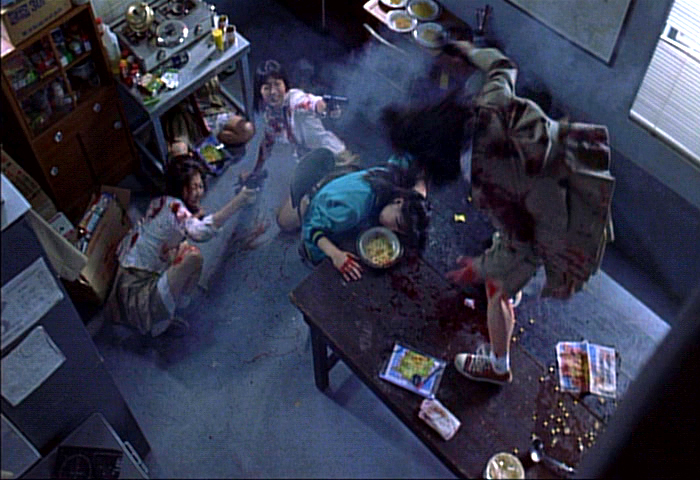
So, you thought your schooldays were tough? We have had cinematic portraits of adults vs. schoolkids before -- Jean Vigo’s Zero for Conduct and Lindsay Anderson’s If… come to mind -- but there has never been a indictment of school-age life quite like Kinji Fukasaku’s Battle Royale. In addition to it being the bloodiest of dramas and blackest of satires, Battle Royale is perhaps the most passionate and crazed cinematic declaration of solidarity with a younger generation ever presented on a movie screen.

As wildly popular with young audiences as it was threatening to parliamentarians when released in Japan a year ago, Battle Royale plays a limited run this weekend at Toronto’s Cinematheque Ontario. Since it has so far frightened off every North American distributor, it is likely to be confined to the film society/cinematheque circuit for a while longer. But as so often happens, its suppression will likely both add to its cachet and affirm its political stance.

Battle Royale is a fever-pitched exercise in the theory that reality itself is so close to absurdity that you need twist your picture of it only slightly to send it over the edge into nightmarish satire. In this picture, a class of 42 grade-nine students is kidnapped by state authorities, shipped to a deserted island, and thrown into a for-keeps game of Survivor where they must kill each other until there is only one of them left. If more than one student is still alive after three days, every survivor will be killed. Any resemblance between this process and everyday life for a young person in Japan is absolutely intended.

Battle Royale ever-so-slightly stretches the rules of the already tortuous Japanese educational game so that student life now explicitly becomes a matter of life and death. Life on the island is a school day with weapons; where the intercom recites the morning’s body count to the strains of Strauss’s Radetzky March, and an audiovisual presentation is a videotape of a chirpy young Japanese hostess explaining the island’s deadly rules as if she were explaining a game of twister to a band of summer campers.

The schoolyard bully now finds himself in his dream environment, petty schoolgirl’s arguments are settled with guns, and small groups of frightened students huddle together to survive until they’re brutally reminded that the rules of the game rule out any attempts at solidarity. Some respond with denial (“If I survive, I’ll go to a good school” one fantasizes), but more often the response is nihilism. “What’s wrong with killing?” one student argues. “Everybody’s got their reasons!”

This is not exactly an attitude designed to make educators and parliamentarians feel comfortable, and in general, Battle Royale displays a level of cultural self-examination that would be impossible in an American film -- the closest thing to it in recent American cinema is probably Larry Clark’s Bully. Both films are portraits of the near hopelessness of teen life, but in place of Clarks’ unconditional surrender to despair, Battle Royale concludes that defiance in the face of evil is a viable attitude, and that rebellion -- even if hopeless -- is the only sane act for a young person.

It’s probably simply the raw bloody enthusiasm with which the director makes his point that has disturbed officialdom. The 70 year-old Fukasaku made his name in Yakuza pictures thirty years ago, and Battle Royale is presented with an energy that makes John Woo feel like Antonioni, and an operatic passion that would make Martin Scorsese blush. It skates about the edge of exploitation and feels just slightly immoral. But it is also the new milennium’s first great teen movie: It kicks you in the stomach, but it points to a way of survival.

-Published in the Globe and Mail, 2001

Hana Bi

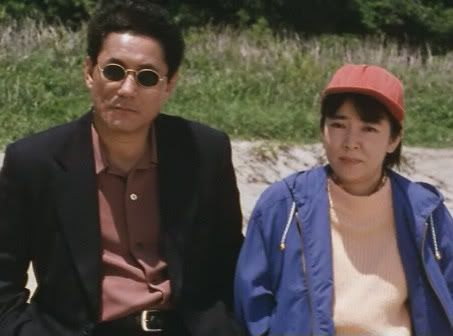
Takeshi Kitano, who is virtually unknown in North America, is Japan’s biggest media personality. Since 1973 he has parlayed a career in standup comedy into seven current TV shows, half-a-dozen regular newspaper columns and 55 books. From 1990 to 1995 he was chosen “favorite TV celebrity” in a nationwide poll, and in 1994 picked (by the same people, presumably) as the man the electorate would most like to see as Prime Minister.

Not surprisingly, he has moved into movies as well. Starting in 1989 with Violent Cop—a film that makes Dirty Harry look like Frasier—he has gone on to direct (and for the most part, star in) seven films. Two of them get a wide North American release this month, thus making us privileged in a way Japanese cinemagoers were not: we get to start with his finest and most mature work.

Not to put too fine a point on it, Takeshi makes gangster movies. He also makes cop movies, and he makes movies where it’s sometimes hard to tell the virtues of one from the virtues of the other. They are films about the honourable life and a good death, and how for cop or yakuza one is usually a part of the other. In Fireworks he’s the cop—although by now such details are probably decided at the script stage by the flip of a coin.

He’s a cop for whom guilt seems the primary driving emotion as well. Yoshitaka Nishi is a man in the midst of losing everything that gives his life meaning: his daughter has just died; his wife is dying of cancer; one of his partners has been killed and another crippled in a bungled stakeout; his job in jeopardy and he’s in hock up to his eyeballs to the yakuza. Nishi’s reaction is novel: he decides to rob a bank so he and his wife can enjoy one last vacation together.

This kind of idea could make a really hideous American comedy-drama—in fact it probably already has—but here it emerges as a story of love and death told with simplicity, elegance, heart and—oddly—humour. This is a very funny movie, especially taking into account the genuine gravity of the proceedings just described. As a director, Takeshi seems to draw on his roots in standup comedy, although as an actor one takes his past as a comic on faith—his face is so impassively stony that you worry a smile might tear it in half. Yet his inscrutability is the key to his filmmaking.

Takeshi makes the simplest movies in the world, and his secret would be well learned by a lot of American filmmakers. What it consists of, quite simply, is the courage to do almost nothing; of having faith in the audience to read into the movie what you need them to. He often gets points across with static images of peoples faces; just turning the camera on and leaving it there for longer than you expect. There’s something very Japanese about this—holding a simple medium shot of an actor and pulling the audience in, instead of pushing the actor out at them with a close-up. A lot of Fireworks is the Triumph of the Impassive Reaction Shot.

What emerges from such a method is paradoxical: everything onscreen (even the quite graphic violence) is restrained and held in, and yet the finished product puts you through the emotional wringer—Fireworks is more moving than just about anything currently in front of a Canadian movie audience. Whether a North American director could get away with it is another matter. It would be nice of someone worked up the courage to try.

-Published in The Globe and Mail, 1998