Monday, September 21, 2009

Max Ophuls

No director made films more beautifully than Max Ophuls, and no other filmmaker seems to have suffered as much in critical esteem for it. To his critics, an Ophuls film is like a Viennese banquet built around a box of take-out éclairs: all virtuoso tracking shots and thrilling long takes, trying desperately to cover up the lack of any substantial literary meat-and-potatoes.

It certainly is easy to be distracted by the beauty of the presentation and miss the profundity at the center of Ophuls’ work, but there is a critic at the heart of the confectioner and a bitter pill at the center of every Ophuls truffle. He made some of the most beautiful social critiques ever filmed, and if it seems perverse of him to pretty up his cultural criticism, it’s probably wise to remember the observation of social philosopher Mary Poppins: a spoonful of sugar does help the medicine go down.

A German by birth, a Frenchman by choice, and multinational by necessity, from 1930 to 1955 Ophuls made movies in Germany, Italy, Austria, Holland, Hollywood, and France. His favorite setting for a movie was turn-of-the-century Vienna, but it could as well have been anywhere the wealthy or powerful man prowled. His favorite subject was the woman unhappily and unproductively in love with one of the prowlers.

For this his work was often deemed inconsequential. A remark by film scholar Roy Armes is typical of this school of thought: “Max Ophuls was a man of wide cultural interests and had a deep respect for literature, yet the characteristic of his subject matter is its triviality. It is not by chance that his last film in the USA was from a Ladies’ Home Journal story, for Ophuls’ subject matter is the beautiful but unhappy woman.”

Beautiful but unhappy women do figure prominently in the Ophuls canon: In Liebelei, a Viennese musician’s daughter falls in love with a soldier who becomes a victim of a military code that forces him to fight a duel; La Signora di Tutti chronicles the life of an actress destroyed by her relationship with an older man in love with her; Joan Fontane in Letter from an Unknown Woman carries a torch for a dissolute musician (Vienna, again) until the day she dies; in The Earrings of Madame de... a woman dies of a broken heart; the list goes on and on. (There’s even a hint in From Mayerling to Sarajevo that the real tragedy of the 1914 assassination of Archduke Ferdinand and his wife was not that World War One followed as a result, but that a love affair had been cut short.)

Yet it’s tough to see the Ophuls woman unhappily in love as trivial. Take, for example, Caught. Caught (a word that could serve as the title of most of his films) finds Ophuls in 1948 Hollywood doing film noir, which turns out to be a very happy combination: The in-your-face cynicism of the genre brings the social critic into the open; the director’s feverish camerawork raises the emotional temperature to delirious levels.

Caught is sort of a wife’s-eye-view Citizen Kane: Proletarian Leonora Ames models mink coats in a department store and dreams of one day marrying a millionaire. Through circumstances too strange and delightful to go into here, she gets her wish, only to realize that her husband is a vicious control-freak bent on destroying all those around him. (Critic David Thompson claims that Howard Hughes actually gave Robert Ryan advice on how to portray his sociopathic multimillionaire.)

Ultimately, Leonora leaves her husband and her mink-coat lifestyle behind, and finds fulfillment working as a pediatrician’s assistant in a poor neighborhood. (Women in this movie achieve happiness only when their lives find expression through their labor.) Far from feeling frivolous, there are times when Caught feels like it might have been directed by Chairman Mao—that is, if the Great Helmsman could have learned to use a dolly.

Lola Montes (1955) is rather a more baroque matter. Based on the life of a real character who counted among her lovers Franz Liszt and the king of Bavaria, Lola Montes was to be Ophuls’ last film, and an apotheosis of his favorite themes. It was also shockingly modern—a film about filmmaking, a biography about biographies and a statement that we are all mere actors in the theater of our lives.

A circus ringmaster steps into the spotlight and cracks his whip. “Ladies and Gentlemen” he shouts. “The most sensational act of the century! Spectacle! Romance! Action! A creature a hundred times more wild than any beast in our menagerie! A monster of cruelty with the eyes of an angel! Ravaged hearts! Squandered fortunes! A sarabande of lovers! An authentic revolution! Passion and glory! Triumph and perdition! Ladies and gentlemen, Lola Montes—in the flesh!” Curtains part and over the next 110 minutes, we see more or less all of the above, some of it performed on a tightrope and a trapeze. (Lola’s version of what happened: “I simply do as I please.”)

The movie’s formal conceit is so riveting that when it’s all over it’s hard to remember whether anything important went on in its subject’s life. And as with many reinventions of cinema, it’s hard not to find a little sympathy for the complaint of Stuart Klawans, who in Film Follies points out the gap between Lola’s philosophical content and lavishness of its presentation: “The true scandal of Lola Montes is that Ophuls had sneaked something no bigger than a garden folly into a production of World’s Fair Proportions.”

But, critical fashions change. What 40 years ago would have been the defect of self-indulgency is now the virtue self-referentiality. Today, Lola Montes is one of the indispensable works of world cinema precisely because it’s a visit to that world’s fair. If Lola Montes had been the only film he’d ever made, his critics would be right: Max Ophuls would be the Claudia Schiffer of filmmakers, content wildly outstripped by looks.

As it is, Lola Montes merely caps a body of work where spectacle and opulence and cinematic bravura are always held in check by a great sadness about the fleeting nature of love and happiness in the modern world. “Who am I?” the director asks at the opening of La Ronde. “The author? The narrator...? I am you—I am the personification of your desire to know everything. People always know only one side of reality because they see only one side of things. But I see every aspect. I see from every side....”

Ophuls’ career of seeing from every side was, at 25 years, tragically too short: The chronicler of broken hearts died of heart disease at 54. François Truffaut wrote in his 1957 Cahiers du Cinema obituary: “For some of us, Max Ophuls was the best French filmmaker, along with Jean Renoir. Our loss is immense, the loss of a Balzacian artist who was an advocate of his heroines, an accomplice of women, our bedside filmmaker.”

Published in the Globe and Mail, 1999

Wednesday, July 8, 2009

Battle Royale

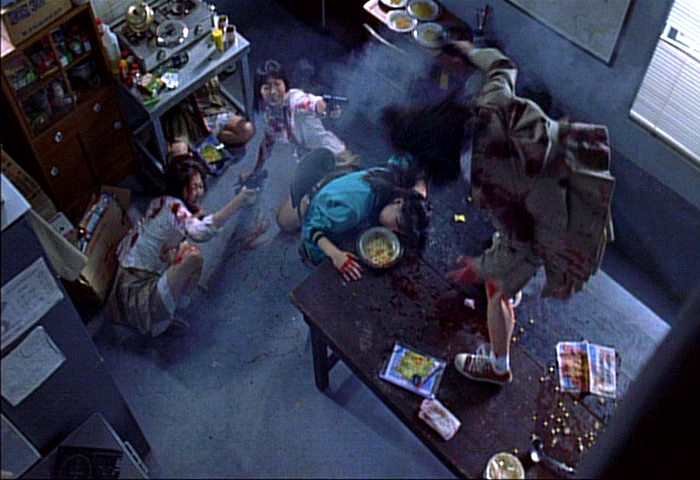
So, you thought your schooldays were tough? We have had cinematic portraits of adults vs. schoolkids before -- Jean Vigo’s Zero for Conduct and Lindsay Anderson’s If… come to mind -- but there has never been a indictment of school-age life quite like Kinji Fukasaku’s Battle Royale. In addition to it being the bloodiest of dramas and blackest of satires, Battle Royale is perhaps the most passionate and crazed cinematic declaration of solidarity with a younger generation ever presented on a movie screen.

As wildly popular with young audiences as it was threatening to parliamentarians when released in Japan a year ago, Battle Royale plays a limited run this weekend at Toronto’s Cinematheque Ontario. Since it has so far frightened off every North American distributor, it is likely to be confined to the film society/cinematheque circuit for a while longer. But as so often happens, its suppression will likely both add to its cachet and affirm its political stance.

Battle Royale is a fever-pitched exercise in the theory that reality itself is so close to absurdity that you need twist your picture of it only slightly to send it over the edge into nightmarish satire. In this picture, a class of 42 grade-nine students is kidnapped by state authorities, shipped to a deserted island, and thrown into a for-keeps game of Survivor where they must kill each other until there is only one of them left. If more than one student is still alive after three days, every survivor will be killed. Any resemblance between this process and everyday life for a young person in Japan is absolutely intended.

Battle Royale ever-so-slightly stretches the rules of the already tortuous Japanese educational game so that student life now explicitly becomes a matter of life and death. Life on the island is a school day with weapons; where the intercom recites the morning’s body count to the strains of Strauss’s Radetzky March, and an audiovisual presentation is a videotape of a chirpy young Japanese hostess explaining the island’s deadly rules as if she were explaining a game of twister to a band of summer campers.

The schoolyard bully now finds himself in his dream environment, petty schoolgirl’s arguments are settled with guns, and small groups of frightened students huddle together to survive until they’re brutally reminded that the rules of the game rule out any attempts at solidarity. Some respond with denial (“If I survive, I’ll go to a good school” one fantasizes), but more often the response is nihilism. “What’s wrong with killing?” one student argues. “Everybody’s got their reasons!”

This is not exactly an attitude designed to make educators and parliamentarians feel comfortable, and in general, Battle Royale displays a level of cultural self-examination that would be impossible in an American film -- the closest thing to it in recent American cinema is probably Larry Clark’s Bully. Both films are portraits of the near hopelessness of teen life, but in place of Clarks’ unconditional surrender to despair, Battle Royale concludes that defiance in the face of evil is a viable attitude, and that rebellion -- even if hopeless -- is the only sane act for a young person.

It’s probably simply the raw bloody enthusiasm with which the director makes his point that has disturbed officialdom. The 70 year-old Fukasaku made his name in Yakuza pictures thirty years ago, and Battle Royale is presented with an energy that makes John Woo feel like Antonioni, and an operatic passion that would make Martin Scorsese blush. It skates about the edge of exploitation and feels just slightly immoral. But it is also the new milennium’s first great teen movie: It kicks you in the stomach, but it points to a way of survival.

-Published in the Globe and Mail, 2001

Hana Bi

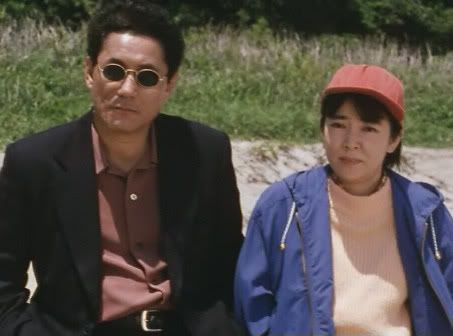
Takeshi Kitano, who is virtually unknown in North America, is Japan’s biggest media personality. Since 1973 he has parlayed a career in standup comedy into seven current TV shows, half-a-dozen regular newspaper columns and 55 books. From 1990 to 1995 he was chosen “favorite TV celebrity” in a nationwide poll, and in 1994 picked (by the same people, presumably) as the man the electorate would most like to see as Prime Minister.

Not surprisingly, he has moved into movies as well. Starting in 1989 with Violent Cop—a film that makes Dirty Harry look like Frasier—he has gone on to direct (and for the most part, star in) seven films. Two of them get a wide North American release this month, thus making us privileged in a way Japanese cinemagoers were not: we get to start with his finest and most mature work.

Not to put too fine a point on it, Takeshi makes gangster movies. He also makes cop movies, and he makes movies where it’s sometimes hard to tell the virtues of one from the virtues of the other. They are films about the honourable life and a good death, and how for cop or yakuza one is usually a part of the other. In Fireworks he’s the cop—although by now such details are probably decided at the script stage by the flip of a coin.

He’s a cop for whom guilt seems the primary driving emotion as well. Yoshitaka Nishi is a man in the midst of losing everything that gives his life meaning: his daughter has just died; his wife is dying of cancer; one of his partners has been killed and another crippled in a bungled stakeout; his job in jeopardy and he’s in hock up to his eyeballs to the yakuza. Nishi’s reaction is novel: he decides to rob a bank so he and his wife can enjoy one last vacation together.

This kind of idea could make a really hideous American comedy-drama—in fact it probably already has—but here it emerges as a story of love and death told with simplicity, elegance, heart and—oddly—humour. This is a very funny movie, especially taking into account the genuine gravity of the proceedings just described. As a director, Takeshi seems to draw on his roots in standup comedy, although as an actor one takes his past as a comic on faith—his face is so impassively stony that you worry a smile might tear it in half. Yet his inscrutability is the key to his filmmaking.

Takeshi makes the simplest movies in the world, and his secret would be well learned by a lot of American filmmakers. What it consists of, quite simply, is the courage to do almost nothing; of having faith in the audience to read into the movie what you need them to. He often gets points across with static images of peoples faces; just turning the camera on and leaving it there for longer than you expect. There’s something very Japanese about this—holding a simple medium shot of an actor and pulling the audience in, instead of pushing the actor out at them with a close-up. A lot of Fireworks is the Triumph of the Impassive Reaction Shot.

What emerges from such a method is paradoxical: everything onscreen (even the quite graphic violence) is restrained and held in, and yet the finished product puts you through the emotional wringer—Fireworks is more moving than just about anything currently in front of a Canadian movie audience. Whether a North American director could get away with it is another matter. It would be nice of someone worked up the courage to try.

-Published in The Globe and Mail, 1998

Sunday, June 28, 2009

Shohei Imamura: An Introduction to Anthropology


When Japanese writer-director Shohei Imamura was announced as the co-winner of the Palm D’Or at the 1997 Cannes film festival, a lot of people in the audience—the TV audience at least—probably thought “who?” North American knowledge of Japanese film generally begins and ends with Akira Kurosawa (not least because so many of his films have been remade by western filmmakers—Seven Samurai as The Magnificent Seven; Yojimbo as A Fistful of Dollars, and so on). Imamura, even though three of his last four movies have won major prizes at Cannes, remains unknown—virtually none of his films have enjoyed even a reasonably-sized North American release.

That is about to change. “Pigs, Pimps and Pornographers”, a complete retrospective of Imamura’s pre-1997 theatrical features, begins an 11-city tour tonight at Cinematheque Ontario. Cinematheque is also concurrently launching the first English-language book of essays by and about the director, called, simply, “Shohei Imamura”.

The man is worth the hoopla: Imamura surely belongs in the pantheon of the world’s leading filmmakers—he is certainly the greatest one that nobody seems to have heard of. Over four decades, Imamura has produced a consistently excellent body of work peppered with half-a-dozen masterpieces; his persistent absence from the art-house repertory is a crime. It’s an omission on the order of magnitude of ignoring Fellini—and I’m not certain that the comparison doesn’t favour Imamura.

After taking in a few of his movies—one doesn’t so much watch as be taken hostage by them—it is possible to scrape up some sympathy for a distributor. They are a tough sell: they are in a language that is not only foreign but utterly foreign, they deal with a culture with few connecting points to our own, and the occidental neophyte may simply have trouble keeping track of Asian faces. (Following the action sometimes requires heroic attention: the ensemble of characters in Eijanaika makes Ben-Hur feel like My Dinner With Andre). Most obviously though, they are movies about people or groups of people who, frankly, just ain’t very nice—or as Imamura puts it: “I am interested in the relationship of the lower part of the human body and the lower part of the social structure”.

In the right combination, both turn out to be pretty interesting places. The idea seems to be that the best way to get at the heart of a society is to sniff around at the edges, so Imamura movies tend to be peopled with hideous husbands and murderous wives, prostitutes, radiation victims, and people on the outer reaches of civil society with no desire to get to the inside. “You’re old-fashioned,” declares a character in The Pornographers. “We all want to be animals. No one wants to be human; we want to be free but society won’t let us.”

There is a hint through all of Imamura’s work that we aren’t really all that much more than animals—albeit animals with the gift of consciousness—and he seems to delight in showing us how little progress we’ve made as a society, or even as a species. Life’s chief preoccupation is simply getting by, and “food and sex are life’s only pleasures” according to another character in The Pornographers.

Food, sex, and what people do to get by are certainly Imamura’s chief preoccupations. The simple struggle for food is the centre of community existence in The Ballad of Narayama, the story of a village in northern Japan where in a tough year children get tossed into snowbanks or sold, and the aged are hauled up to the local mountaintop to die. In The Insect Woman, a woman struggling to escape a Narayama-like rural existence moves to Tokyo and finds her calling as the boss of a call-girl service. In Intentions of Murder, a housewife struggles against a violent, unfaithful husband, his mistress, her spiteful in-laws and a burglar who first rapes her and then falls obsessively in love with her. (She wins.) In The Pornographers, a little man is driven mad by his life in the porn business. In Black Rain, Hiroshima survivors muddle through a class system where social standing is now based on health rather than wealth. It’s all just getting by.

All this leads to a paradox: There may not be a single noble act on any character’s part in the entire Imamura canon—morally it’s all on about the level of home movies of Stalin wrestling alligators—yet they are the most elevating movies imaginable. How does he pull that one off? There is of course the awful possibility that he’s simply right and our pleasure is simply the joy of self-recognition.

I prefer to think he’s got making movies down right. Imamura makes films like an anthropologist raised on Aristotle’s Poetics: even though there isn’t a hint of tragedy in his work—sometimes it feels like there’s nobody behind the camera—he gets from his characters what Aristotle demanded of tragedy. They arouse pity and fear in you: pity for creatures at the edge of human existence; fear that you aren’t so very different from them. You feel a great intimacy with that which was until recently strange, and you are moved by it. His characters take a rough journey and it’s we who are left feeling a basic humanity as a result.

This is not to ignore all the other miscellaneous delights of Imamura’s films: The marvelous 60’s feel to the gorgeous black-and-white widescreen photography of the early movies; their deadpan wallowing in the unacceptable; their irrepressible humour even at what seems the end of the world (parts of Black Rain, a movie about Hiroshima, suggest what Fellini’s Amarcord might have looked like if the bomb had been dropped on Italy) and their farcical delight in depravity (by comparison to The Pornographers, Boogie Nights is an exercise in wholesomeness and good taste.) They are a complex experience, as life is: profound, exciting, moving, funny and ultimately, exhausting.

Mostly exhausting. Shohei Imamura is one of cinema’s greatest artists for perhaps the simplest reason in the world: he gives you everything. His films are complete—the whole story of life in every package. They fill you up and you leave the theatre suffused with gratitude for this vision of a civilization heretofore a mystery to you. Indeed, the best subtitle I can think of for this series is “everything I ever needed to know about Japan, I learned from Shohei Imamura”.

—Published in the Globe and Mail, 1997

Thursday, February 14, 2008

Funny Girl after 9/11


1968’s Funny Girl, a restored version of which opens in Canada this weekend, may very well be the last bearable movie musical Hollywood ever made. Refugees from Mariah Carrey’s Glitter who find their way in front of a screen playing Funny Girl may well have some trouble comprehending exactly where they’ve landed. But kids will understand this artifact immediately: it’s just like The Little Mermaid, except that it’s done with real people and there’s a hydrogen bomb disguised as a woman at the center of things.
The movie musical was dying of anachronism right about the time Funny Girl was released---if there had been multiplexes at the time, it might just have shared a roof somewhere with Jean-Luc Goddard’s Week-End. Nominally a musical biography of vaudeville and radio star Fanny Brice, Funny Girl survived because it was Barbara Streisand’s Hollywood coming-out. The film made her a superstar and she returns the favor in kind: she is in virtually every scene and her charisma pours out of every frame.
The result, periodically, is emotionally overpowering. Everything in the film’s structure leads us on to a trio of overwhelming moments; each a musical number, all sung by Streisand alone: People, Don’t Rain on My Parade, and My Man. Nothing else in the movie comes close to matching these set-pieces, and in retrospect the rest of the film sometimes feels like an elaborate set-up.
Dramatically this puts a lot of performers in the shade---whatever isn’t within the emotional arc of Streisand’s character ends up superfluous. There are a couple of musical numbers that cry out to be shortened, and as her ultimately good-for-nothing husband Nick Arnstein, Omar Sharif is often left twisting in the wind. He is well-oiled and efficient as a handsome physical presence for Streisand to make eyes at, but ineffective as an emotional presence for her to react to. Unfortunately, Sharif reminds you that a lot of Funny Girl is A Star is Born without James Mason.
Fortunately, at that stage of her career, all-Barbara, all-the-time was just about enough. Funny Girl is a very simple movie---almost like a Dogme 95 presentation by contrast to some current musical entertainments. William Wyler’s direction is understated and motivated by a simple principle: Put somebody magnetic in front of a camera and let her do her thing.
If Funny Girl has become something of a dinosaur wandering through the theaters, it is of value for more than the cinematic paleontologist or the Streisand cultist. The visual medium in the television age has so compellingly become a vehicle for the delivery of real-world horror, that viewers seem no longer able to make the intellectual and emotional leap required to accept people bursting into song on a screen in front of them. The musical survives in the theater and in the animated cartoon---spaces where you park your visions of the real world at the door. But the movie musical is viable only in that psychic space we leave open for nostalgia.
Funny Girl is solid entertainment which at its most rarefied moments is pin-you-to-your-seat exhilarating. (A 26 year-old Barbra Streisand, lit by a single light and singing My Man on a Panavision screen, is more cinematically potent than Arnold Schwarzenegger tearing a jumbo jet apart with his bare hands.)
But it is the movie of the moment because it delivers you to an era before the World Trade Center even existed; a place where you still believed people would break into song on a movie screen just to get something off their chests. A 33 year-old movie musical like Funny Girl is more than just a nostalgic link to a better time. It offers us a glimpse of a more innocent vision of ourselves.

-Published in the Globe and Mail, 2001

Monday, February 11, 2008

Kiefer Sutherland in 2002

He’s not the archetypal Canadian actor; but he may well be the archetypal Canadian actor in Hollywood: More competent than many of the performers who surround him, he remains something of an outsider. For reasons obscure to everyone but perhaps himself, real stardom steadfastly refuses to attach itself to Kiefer Sutherland.

By the early 90’s, his brat-pack days over, Sutherland seemed to be inching towards a consistent film persona. Among the Charlie Sheens and Chris O’Donnells crashing in anachronistic flames about him, he alone looked comfortable with a saber in his hand and a horse between his legs in The Three Musketeers. In the otherwise forgettable The Cowboy Way he carved out a respectable portrait of a modern Western Man; a dignified, denim presence next to whom co-star Woody Harrelson seemed a refugee from Hee Haw.

You got the sense that if he had been born 40 years earlier Sutherland might have had a good career as a western star. His most effective character type is reminiscent of a Joel McCrea or a diminutive Gary Cooper---the reluctant, laconic, self-effacing man of action. Taking on that kind of cinematic persona cannot be a calculated act in contemporary Hollywood---in a place where actors prefer to be seen as gods, nobody writes leading characters like that any more. No, he does it because it’s genuine.

Hollywood has thus not been kind to him recently. The quiet, self-effacing leading man has been cast as: a drooling child-killer in Eye For an Eye; a racist cracker and clansman in A Time to Kill; a demented Peter Lorre imitator in Dark City; a snarling, corrupt lawman in Picking up the Pieces; a psychotic child psychiatrist in Freeway; a porn director in The Last Days of Frankie the Fly…. For a long time now there’s been a sense of him punching the clock and producing a body of work designed for the compulsive video renter but not many others.

From there it doesn’t seem a major career jump to a television series, but 24 will likely prove to be the best thing that’s happened to him in years. The show is slick, professional and compulsively presented, but most important, Sutherland plays a character that suits him. His Jack Bauer in 24 is professional and understated; a man in a world of duplicity and espionage struggling to reconcile his job with his desire to be a competent family man.

The sense you get looking at Kiefer Sutherland as he makes his actor’s way through the world feels awfully similar. When script and role allow, he too is very good at the charade that is his profession. But most of all, he simply seems to be someone trying to lead a normal life. As both actor and man he seems to echo Joel McCrea’s words in Sam Peckinpah’s Ride the High Country: “I just want to be able to enter my house justified.”

-Published in Flare, 2002

Obituary: Arnold Schwarzenegger 1984---2001


It is with deep regret that we announce the passing of Arnold Schwarzenegger’s career as a major movie star. He succumbed after a lengthy and apparently congenital illness that also killed many close relatives. Schwarzenegger was predeceased by his fraternal twin Sylvester Stallone, cousin Chuck Norris and nephew Jean-Claude Van Damme. (His cousin Steven Seagal is still in a coma but apparently reviving.)
Arnold will be sadly missed and lovingly remembered by his agent.
The most immediate symptom of his impending career-failure was the decision of Warner Bros. to release Collateral Damage in October, thus abandoning any pretense of it being a potential big-money earner for them. At the peak of his health, Schwarzenegger dominated the traditional blockbuster month of June like a colossus, when often no rival studio would dare release a movie against him. Observers have since noted ominously that he hasn’t had a lead role in a summer blockbuster since 1996.
Long-term cause of death was likely Hollywood’s tendency of late to star real actors in big-ticket action movies (see: Face Off, The Matrix, Mission Impossible et al); the passing from fashion of the Mr. Olympia physique and the emergence of the Brad Pitt look; and viewers noticing that as a 50+ survivor of bypass surgery Schwarzenegger lacked credibility as an action hero. Some journals have floated the unkind theory that later in his career people were finally able to understand his dialogue, which hastened his decline. (This has yet to be confirmed in a peer-reviewed publication.)
A consensus appears to be emerging that it was simply bound to happen sooner or later: The birth of his career as a superstar was largely a biological accident; a tendency at beginning of the 80’s for filmmakers to cast kickboxers and athletes as action stars. Being an abnormality, this cinematic plague tends to be self-limiting: it comes in cycles, builds momentum and then kills off its food supply---in this case audiences composed of cement-headed grunts and people losing date-movie coin-tosses.
Beginning in 1970’s Hercules Goes Bananas (as ‘Arnold Strong’), Schwarzenegger’s career moved in fits and false starts until career physician James Cameron’s epochal decision to cast him as a machine in 1984’s The Terminator. Finding the persona most within his reach launched him into superstardom, where for many years he was Hollywood’s highest-paid performer, whose movie budgets regularly set records.
Yet, rumors of cinematic ill-health had been spreading for several years and the broadening of his taste in roles has hurt his appeal, once stated succinctly by the late Jay Scott: “He can do nothing. Therefore he can do anything.” Cinematic infibrilation is planned to attempt a career restart (Terminator 3) but the absence of Dr. Cameron from the project will limit its effectiveness. Resuscitation seems unlikely.
Funeral arrangements are by Planet Hollywood. Pallbearers will be Bruce Willis, John Travolta, Chow Yun-Fat, Sigourney Weaver, Keanau Reeves and Nicolas Cage. In lieu of flowers, donations may be made to the 2002 Governor’s Campaign of the Republican Party of California.

-Published in Flare, 2001